Side Hustle Launch Playbook: MVP, Pricing & First Customers
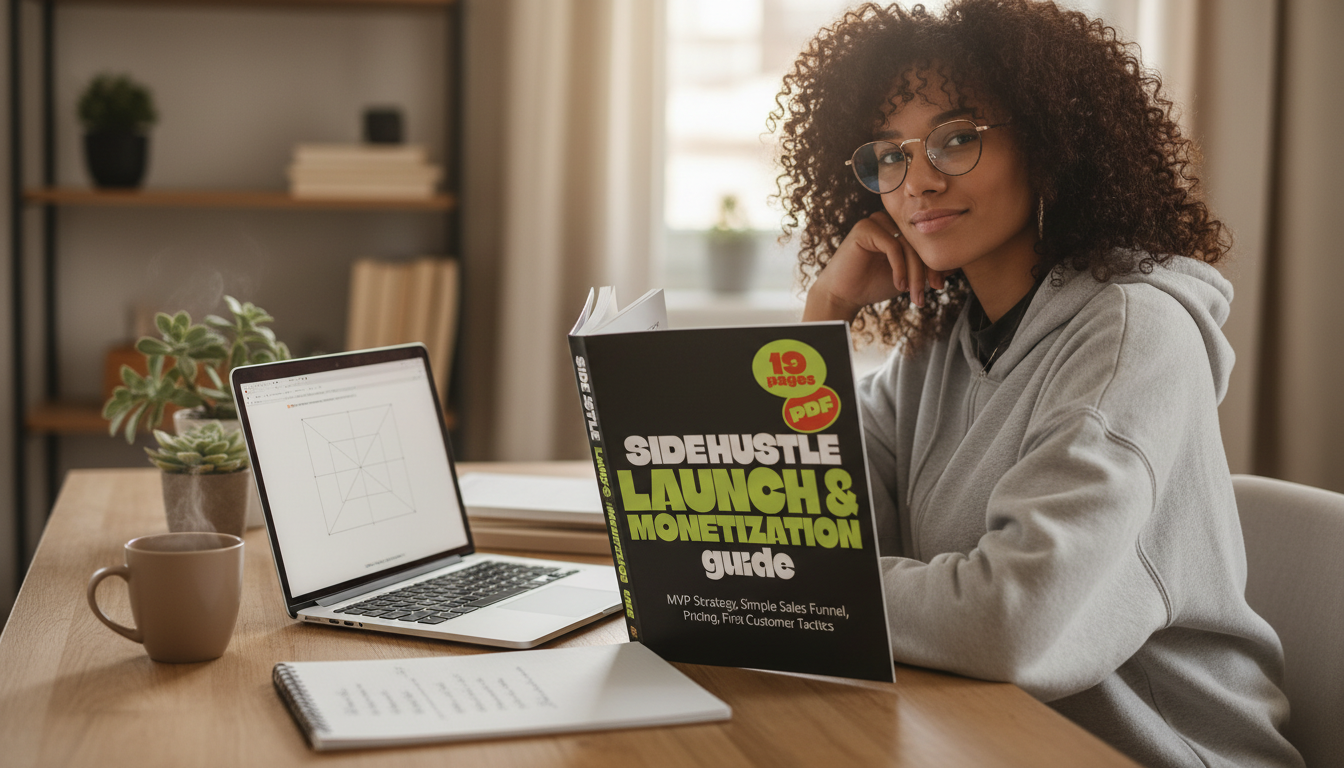
Side Hustle Launch & Monetization Playbook: MVP, Pricing, Funnel, and First Customers
A low-risk side hustle becomes real when it moves from idea to an offer someone pays for. The fastest path is rarely “build more”—it’s narrowing the problem, selling a minimum viable offer, and collecting proof while your time and budget are still limited. This playbook breaks the launch into small, testable steps: define a buyer, create an MVP offer, set pricing you can defend, put a simple funnel in place, and use repeatable outreach tactics to land the first customers without over-investing.
Start with a narrow problem and a specific buyer
Momentum starts when the buyer is clear. Instead of “small businesses,” choose “local chiropractors,” “new Etsy sellers,” or “busy project managers in SaaS.” The goal is a customer type with a problem that is frequent, expensive, urgent, or emotionally heavy (time, money, anxiety, compliance, outcomes).
- Write a one-sentence promise: “Help [buyer] get [result] without [common pain].” Example: “Help boutique gyms fill weekday classes without relying on discounting.”
- Pick a delivery format that fits limited hours: templates, short coaching, a productized service, a micro-course, or a done-with-you setup.
- Define week 1–2 success metrics: conversations booked, sign-ups, paid pilots, or deposits collected (not followers gained).
If your schedule is tight, design for speed and boundaries: fixed scope, fixed timeline, and one clear outcome.
Validate fast with an MVP offer (not a perfect product)
Your MVP is the smallest version that proves willingness to pay. It’s not a logo, a brand kit, or a full course. It’s a paid step that creates a measurable result quickly.
- Build the smallest paid offer: a paid workshop, a paid audit, a starter package, or a template bundle.
- Deliver manually first: personalized emails, live calls, and simple checklists teach you what to automate later.
- Pre-sell with a tight scope: “7-day turnaround” or “2 sessions + deliverables” reduces risk for both sides.
- Collect proof immediately: before/after examples, screenshots, and testimonials tied to specific metrics.
MVP options that work well for a time-limited side hustle
| MVP type | Best for | What to build | Signal of success |
|---|---|---|---|
| Paid diagnostic/audit | B2B or professional services | Intake form + 45-min call + short action plan | At least 3 paid bookings in 2 weeks |
| Productized starter package | Repeatable services | One-page scope + fixed deliverables + fixed timeline | 50%+ of leads accept the fixed scope |
| Template/toolkit | Creators and operators | Editable files + quick-start guide | Conversion rate improves after 5–10 buyer interviews |
| Micro-workshop | Teaching/consulting | 60–90 min live session + replay + worksheet | Participants ask for next-step offer |
Pricing that avoids undercharging and overthinking
Pricing gets easier when it’s tied to constraints and outcomes. Buyers pay more for speed, risk reduction, convenience, and avoided costs than for hours.
- Anchor to value: “Reduce onboarding time by 30%,” “avoid penalties,” “ship in 7 days,” or “remove 10 hours/week of admin.”
- Start with 2–3 tiers: self-serve entry, core offer, premium with speed or access. This lets budget buyers self-select without dragging down your main offer.
- Use a decision rule for changes: adjust after 10–20 sales or 15–30 conversations, not after one “no.”
- Add careful guarantees: conditions should be explicit (for example, “submit inputs by X date”) so you reduce hesitation without promising impossible outcomes.
For deeper pricing models and positioning approaches, Stripe’s guide is a helpful reference: https://stripe.com/guides/pricing-strategies.
Build a simple sales funnel that fits a side hustle schedule
A side hustle funnel should be boring and repeatable. One channel, one landing page, one nurture sequence, one conversion step, and one follow-up loop.
When you need practical guidance on marketing basics and sales operations, the U.S. Small Business Administration has a solid overview: https://www.sba.gov/business-guide/manage-your-business/marketing-sales.
First-customer tactics that work without a big audience
If you want a simple way to plan weekly outreach and delivery goals without losing focus, use a lightweight planner like the Goal-Setting Guide for Real Results – Printable Goal Planner, SMART Goals Workbook & Productivity Template for Achievable Success to set targets (conversations, deposits, delivery deadlines) and review progress every 7 days.
How to choose a low-risk side hustle path (when time and budget are tight)
The lean startup method reinforces this approach: test assumptions quickly, learn from real buyers, and iterate based on evidence rather than opinions. A useful perspective is outlined here: https://hbr.org/2013/05/why-the-lean-start-up-changes-everything.
A focused step-by-step playbook to put it all together
FAQ
How quickly can a side hustle get its first paying customer?
With warm outreach and a clear paid MVP (audit, starter package, or workshop), first payments often happen in days to a couple of weeks. Cold channels usually take longer because they require more touchpoints, so consistent daily outreach volume and a tight scope/timeline matter.
What is the simplest MVP that can be sold without building a full product?
A paid diagnostic/audit, a productized starter package, or a micro-workshop are simple to sell because they’re time-boxed and easy to explain. Pre-selling and manual delivery reduce risk while giving you real buyer feedback to shape the next version.
Should pricing start low to get traction?
Starting low can backfire by attracting the wrong buyers and forcing vague scope. Use 2–3 tiers and outcome-based framing, then adjust pricing only after enough data (roughly 15–30 sales conversations or 10–20 sales), not after a single rejection.












Leave a comment