Productivity Blueprint: 90-Day Goals, Time Blocks, Routines
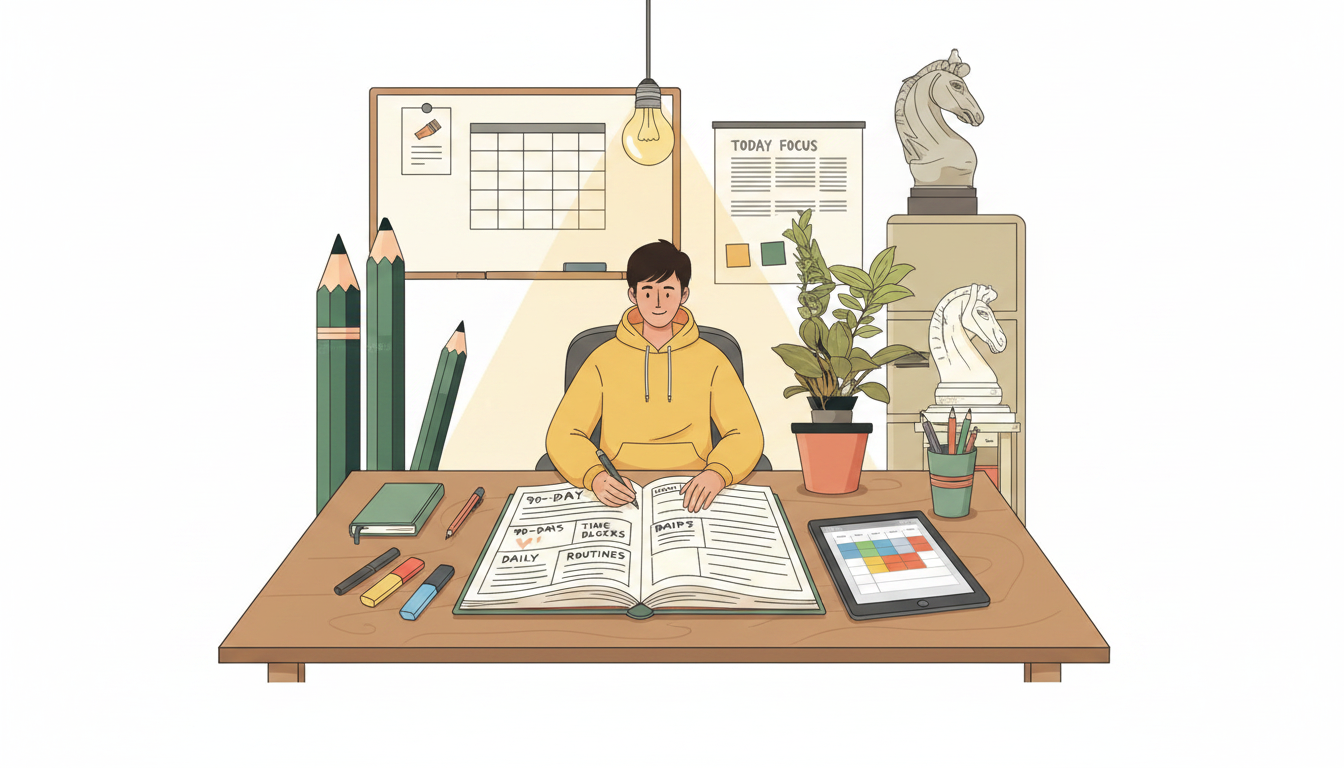
The Ultimate Productivity Blueprint: A Practical System for Goals, Time, and Daily Routines
Productivity improves fastest when goals, time management, and routines work as one system. This blueprint turns big priorities into clear outcomes, protects time for focused work, and builds daily habits that hold up on busy weeks. Use the steps below to set direction, plan realistically, and follow a repeatable routine that reduces overwhelm and increases follow-through.
Start with outcomes, not tasks
To get traction, begin by defining what “done” looks like instead of collecting more to-dos. Outcomes create a finish line; tasks are just possible routes.
- Define 1–3 outcomes for the next 90 days. Examples: ship a portfolio site, finish a certification, stabilize a morning routine.
- Write observable success criteria. Ask: what will be different, visible, or measurable when this is achieved?
- List constraints upfront. Note real time available, energy patterns, and fixed obligations so the plan fits your actual week.
- Choose one “lead outcome.” When everything feels urgent, the lead outcome gets first claim on Focus Blocks.
If motivation fades quickly, build “if-then” triggers for the first action (e.g., “If it’s 9:00 a.m., then I open the course and watch one lesson”). This style of planning is aligned with what psychologists call implementation intentions.
Learn more: Implementation Intentions and Goal Achievement (APA Dictionary of Psychology).
Turn goals into an execution map
Outcomes become doable when they’re translated into milestones and next actions you can finish in one sitting. This reduces ambiguity and helps you restart quickly after interruptions.
- Break each outcome into 3–5 milestones that can be completed in 1–3 weeks.
- Convert milestones into next actions sized for 15–90 minutes.
- Assign an owner, due window, and definition of done for each action (even if the owner is you).
- Keep a short “Now” list (max 5–7 actions). Park everything else in a backlog to reduce decision fatigue.
| Outcome | Milestone (1–3 weeks) | Next action (one sitting) | Definition of done |
|---|---|---|---|
| Complete a 10-lesson course | Finish lessons 1–3 | Watch lesson 1 + take notes (45 min) | Notes saved + 5 key takeaways listed |
| Improve fitness consistency | Train 3x/week for 2 weeks | Schedule 3 workouts on calendar (10 min) | Three sessions blocked with reminders |
| Launch a simple landing page | Draft copy + structure | Write headline + 3 benefit bullets (30 min) | Copy pasted into draft doc |
Use time blocks that match energy and attention
Time blocking works best when it’s built around how attention rises and falls during the day. Instead of treating every hour the same, create a schedule that respects your “peak focus” windows.
- Create two block types: Focus Blocks (deep work) and Admin Blocks (email, logistics, small tasks).
- Place Focus Blocks during naturally higher attention. Protect them from meetings, messaging, and notifications.
- Batch similar tasks in Admin Blocks to reduce context switching (messages, scheduling, finances).
- Set a shutdown time so work doesn’t expand into every open hour.
Energy and alertness are influenced by your circadian rhythms, so it’s worth noticing when you reliably feel sharp versus foggy and adjusting blocks accordingly.
Reference: Circadian Rhythms (National Institute of General Medical Sciences).
A daily routine that keeps priorities visible
Routines reduce re-planning. The goal isn’t a perfect day; it’s a repeatable pattern that makes the next right step obvious.
- Morning setup (5–10 minutes): pick 1–3 priorities and confirm the first Focus Block start time.
- Midday reset (3–5 minutes): check progress, adjust the next block, and remove one distraction (tabs, phone, notifications).
- Evening shutdown (5–10 minutes): capture loose tasks, choose tomorrow’s first action, and stop at a defined endpoint.
- When off-track: return to the smallest next action instead of rewriting the whole plan.
| Time window | Block type | Purpose | Rules |
|---|---|---|---|
| Morning | Focus Block | Most important work | Phone away; single task; timer on |
| Late morning | Admin Block | Messages and coordination | Batch replies; no deep work here |
| Afternoon | Focus Block | Second priority work | One project only; short break midway |
| End of day | Shutdown | Plan tomorrow, close loops | Write first action; clear desk; log progress |
Build a friction-free system for tracking
A good tracking setup reduces mental load. If your system creates extra steps, you’ll stop using it during busy weeks—exactly when you need it most.
- Pick one home base for tasks and planning (digital guide, notes app, or planner) and avoid duplicating lists.
- Use three horizons: Today (commitments), This Week (scheduled blocks), Backlog (ideas and later tasks).
- Create a capture habit: when a task appears, capture it in 10 seconds instead of holding it in memory.
- Review weekly: note completed milestones, decide what to drop, and schedule only what fits your real calendar.
Background: Cognitive Load Theory (SimplyPsychology).
How to choose a productivity guide that actually gets used
Put the blueprint into motion with a ready-made framework
For a simple, ready-to-use setup, try this in-stock option: Goal-Setting Guide for Real Results – Printable Goal Planner, SMART Goals Workbook & Productivity Template for Achievable Success.
FAQ
How many goals should be worked on at the same time?
Aim for 1 lead outcome plus 1–2 supporting outcomes in a 90-day window. More than that usually dilutes Focus Blocks and increases schedule conflicts, which slows completion.
What if the routine breaks after a busy week?
Run a reset: restart one smallest habit (like a 5-minute morning setup), re-block a single Focus Block, and do a quick weekly review to shrink the plan back to what’s realistic.
Is time blocking still useful with an unpredictable schedule?
Yes—use flexible blocks (morning/afternoon buckets) and a minimum viable Focus Block (even 20–30 minutes). If the day shifts, re-plan in five minutes by moving the next action to the next available block.










Leave a comment